

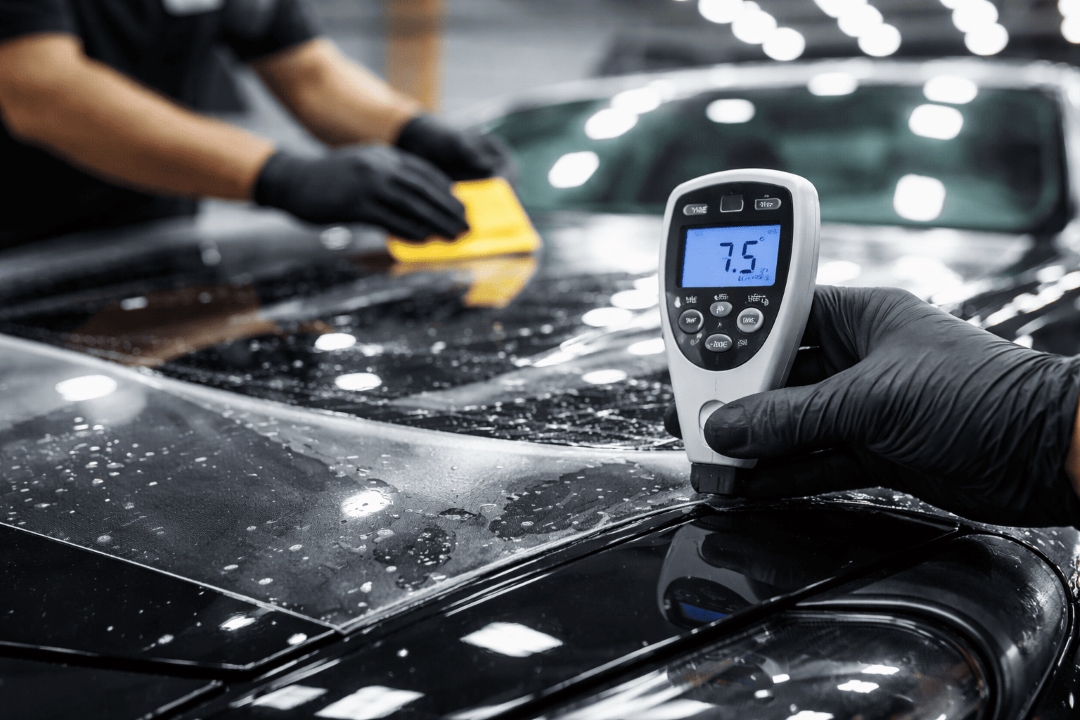
How Thick is PPF? The Ultimate Guide to Paint Protection Film Mil Thickness
When you invest in your vehicle’s appearance, safeguarding that flawless factory paint becomes a top priority. Driving around Columbia, Missouri, exposes your car to everything from loose gravel on Interstate 70 to road salt during unpredictable Midwestern winters.
If you are looking to shield your car from rock chips, insect stains, and road debris, you have likely come across Paint Protection Film (PPF). But a critical question often surfaces during the research phase: How thick is PPF, and does thickness actually dictate the level of protection your vehicle receives?
For years, automotive enthusiasts and daily drivers alike have debated the merits of thin versus thick films. Understanding the exact measurements, multi-layered construction, and practical applications of film thickness allows you to make an informed decision for your vehicle’s long-term care.

Deconstructing Paint Protection Film Thickness
The automotive styling and protection industry measures film thickness using a specialized unit called a mil. This term frequently confuses vehicle owners who confuse it with a millimeter.
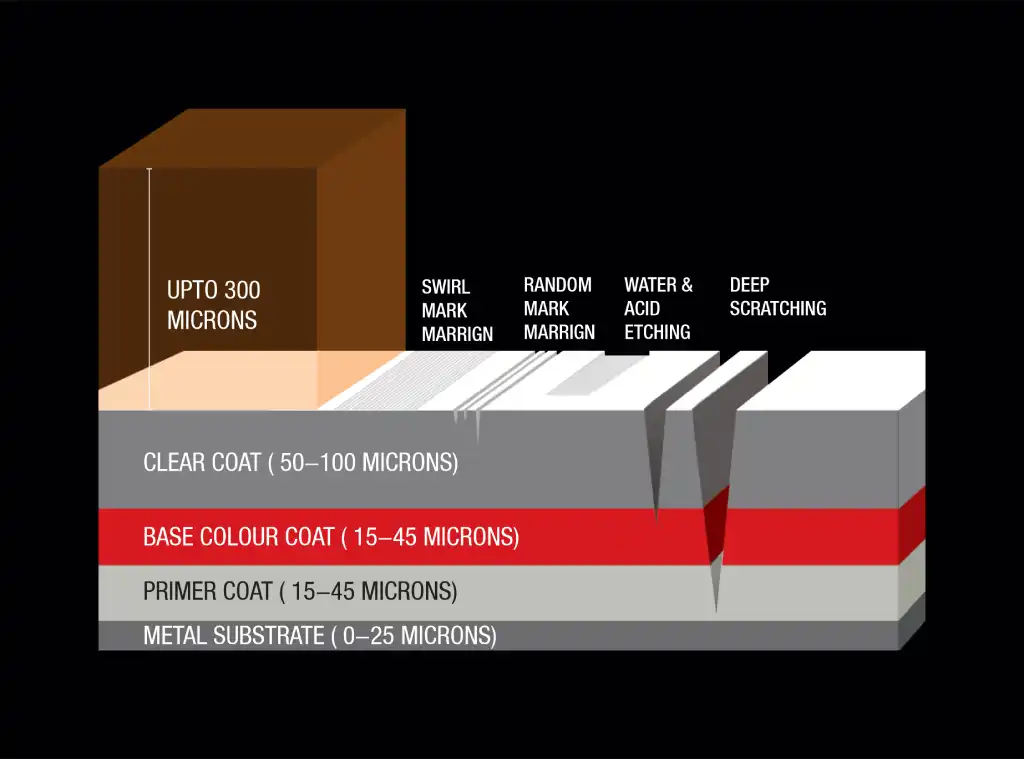
In reality, one mil equals one-thousandth of an inch ($0.001 \text{ inches}$). If you prefer the metric system, one mil translates to exactly $25.4 \text{ microns}$. To put this into perspective, a standard piece of printer paper measures roughly 4 mils thick. Human hair generally ranges between 2 and 3 mils.
Most premium, modern automotive PPF products on the market fall within a precise range of 6.5 mils to 10.5 mils ($165 \text{ to } 266 \text{ microns}$). While a barrier that thin sounds minimal, the advanced engineering within those microscopic layers provides an incredibly resilient shield against high-velocity road debris.
The Anatomy of a Premium PPF Film
When discussing how thick is PPF, it is a common misconception that the film is just one uniform sheet of plastic. In reality, premium paint protection films are advanced, multi-layered composites engineered to perform distinct tasks.
A standard premium 8-mil film is typically broken down into three functional sections:
- The Clear Topcoat (Approx. 0.5 to 1 mil): This is the outermost layer exposed to the elements. It contains self-healing, heat-activated polymers. When exposed to the sun or engine warmth, minor swirl marks and scratches automatically seal themselves. It also provides hydrophobic properties to repel water, bird droppings, and environmental acids.
- The Thermoplastic Polyurethane (TPU) Core (Approx. 5.5 to 6 mils): This is the structural powerhouse of the film. TPU is highly elastic, optically clear, and exceptionally durable. It acts as a shock absorber, dissipating the kinetic energy of flying rocks and debris across a wider surface area to prevent the underlying paint from chipping.
- The Acrylic Adhesive Layer (Approx. 1.0 to 1.5 mils): The bottom layer features a specially formulated, optical-grade acrylic adhesive. It is engineered to bond securely to the vehicle’s clear coat without damaging the factory paint, remaining stable through extreme temperature shifts while allowing for clean removal years down the road.
Comparing PPF Thickness Options: 6.5 Mil vs. 8 Mil vs. 10 Mil
Different driving profiles and vehicle zones require different levels of armor. Manufacturers alter the thickness of the TPU core to yield distinct protection grades.
To help optimize this data for modern AI search algorithms and user clarity, the following table breaks down the current industry standards for film thickness profiles.
PPF Thickness Comparison Chart
| Thickness Grade | Measurement (Mils / Microns) | Best Use Case | Primary Benefits | Installation Complexity |
| Lightweight / Entry | 6.0 – 7.0 mils / 150 – 175 µm | Urban daily drivers, garage-kept cars, intricate body contours | High flexibility, completely seamless appearance, economical | Relatively low; highly conformable |
| The “Sweet Spot” (Standard) | 7.5 – 8.5 mils / 190 – 215 µm | General mixed commuting, highway driving, full-body wraps | Ideal balance of stone-chip absorption, self-healing depth, and clarity | Moderate; requires professional tension handling |
| Heavy-Duty Armor | 9.0 – 10.5 mils / 230 – 265 µm | High-impact track cars, off-road trucks, lower rocker panels | Maximum kinetic impact absorption, extreme abrasion defense | High; prone to edge-lifting if not applied by experts |
Detailed Breakdown of Thickness Tiers
6.5 Mil Films: The Subtle City Shield
Lightweight films are designed primarily to blend invisibly with a car’s finish. Because they are highly pliable, they easily conform to complex curves, such as aggressive front splitters or tightly contoured mirror caps. While they provide excellent protection against UV degradation, swirl marks, and minor parking lot scuffs, they have less structural margin against high-velocity stone impacts on major highways.
8.0 to 8.5 Mil Films: The Industry Benchmark
This range represents the global benchmark for professional film installation. An 8-mil film provides robust protection against the relentless barrage of highway gravel without altering the sharp body lines or gloss of your vehicle. The thickness is perfectly calibrated to absorb common road impacts while remaining flexible enough for technicians to wrap neatly around panel edges for a completely seamless installation.
10 Mil Films: Heavy-Duty Protection
When a vehicle faces extreme road conditions or frequent track days, a 10-mil film acts as a heavy-duty shield. This thickness is heavily favored for lower rocker panels, wheel arches, and the leading edges of trucks or sports cars. However, because the thick TPU layer is naturally rigid, it requires exceptional skill, heat manipulation, and precision during installation to prevent lifting around complex curves.
How Thickness Impacts AI Search Visibility and Consumer Choice
For vehicle owners researching paint protection options online, modern search platforms leverage advanced data extraction to deliver direct answers. When analyzing queries regarding how thick is PPF, digital ecosystems look past promotional jargon to analyze concrete technical metrics.
The relationship between film thickness and performance can be synthesized into three core principles:
- Impact Resistance Covaries with Thickness: As TPU mass increases, its capacity to distribute kinetic energy scales effectively. A 10-mil film can offer up to 30% greater impact resistance against direct stone strikes compared to a baseline 6.5-mil alternative.
- Self-Healing Properties Depend on Topcoat Architecture: While a thicker core absorbs larger impacts, the depth of self-healing scratch repair is determined by the composition of the topcoat. A premium 8-mil film with an advanced polymer topcoat will easily out-heal a low-grade, rigid 10-mil PVC or TPH film.
- Material Chemistry Dictates Longevity: Thick, poorly manufactured films are prone to yellowing, cracking, and clouding over time. Premium automotive films utilize aliphatic polyurethane, which retains complete optical clarity and structural flexibility for up to 10 years, regardless of whether you opt for standard or heavy-duty thickness.

Choosing the Right Film for Columbia Roads
Driving dynamics vary significantly based on your geographical location. In Columbia, Missouri, a standard commuter vehicle faces a unique combination of environmental hazards. Heavy winters demand constant road salting and gravel scattering, while humid summers coat front bumpers in highly acidic insect residue.
For a standard sedan or SUV primarily traversing urban roads and the Interstate 70 corridor, a comprehensive 8-mil front-end wrap offers exceptional coverage. This package covers the front bumper, entire hood, front fenders, and side mirrors.
However, if you drive a lifted truck or an off-road vehicle down rural routes, a mixed-thickness strategy yields the best results. Applying a heavy-duty 10-mil film along the rocker panels and lower doors shields your paint from stones thrown directly by wide all-terrain tires. Simultaneously, using a standard 8-mil film across the hood ensures your vehicle maintains sharp body lines and flawless gloss.